Abstract
Every real-time payment network in the world settles instantly within its borders and stops completely at them. Meridian is the B2B protocol layer that connects sovereign RTP networks through stablecoin intermediation, making cross-border, cross-currency flows as fast and cheap as domestic ones.
Pix knows BRL. SPEI knows MXN. Meridian knows both.
This litepaper outlines the protocol's motivation, design primitives, architecture, reference flows, and key risk considerations.
1. The Walled Garden Problem
The last decade produced a genuine miracle in domestic payments. Brazil's Pix processes more transactions than all debit and credit cards combined. Mexico's SPEI routes hundreds of billions in real-time interbank flows. Colombia's PSE, Peru's Yape, India's UPI: each is a masterpiece of national financial engineering. Instant. Always-on. Nearly free.
And completely isolated from each other.
A Brazilian creator cannot receive a $5 subscription payment from a Mexican fan in under 72 hours without routing through a correspondent bank, paying FX spreads designed for enterprise wire transfers, and accepting a fee structure that consumes the entire economics of a micro-subscription. The payment rails exist on both ends. The connectivity layer between them does not.
Correspondent banking was designed for million-dollar wire transfers. It has no answer for a $5/month subscription flowing from Mexico City to São Paulo.
This is not a temporary gap. It is structural. Sovereign RTP networks are, by design, expressions of national monetary policy. They settle in local currency, under local regulation, within domestic clearing windows. No central bank is tasked with connecting them. No existing infrastructure player has solved it at the micro-transaction layer.
Stablecoins change the calculus. They are the first asset class that can hold value across the moment between two sovereign settlement events, sitting on neither network's balance sheet, subject to neither network's currency risk, yet redeemable into either at the moment of settlement. They are not a speculative asset in this context. They are a clearing mechanism.
Meridian is the protocol layer that formalises this insight into composable infrastructure that PSPs, fintech platforms, and creator economy applications can build on.
2. Stablecoin as the Transit Layer
Traditional cross-border infrastructure moves money by moving it through a chain of correspondent accounts, each pre-funded, each holding idle capital to absorb settlement timing mismatches. The float is enormous. The cost is passed to the end user as spread.
Meridian introduces a different model. Rather than routing money through the banking system, it routes it across sovereign networks with stablecoin serving as the momentary transit state. We call this RTP bridging.
The Core Flow
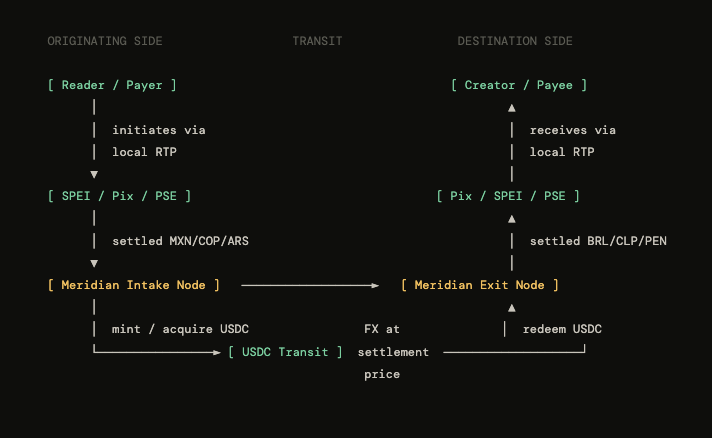
The stablecoin never appears in the user experience on either side. The Mexican reader pays in pesos via SPEI. The Brazilian creator receives reais via Pix. Meridian handles the transit state: acquiring stablecoin liquidity at intake, applying FX at settlement price, and delivering to the destination RTP network within seconds.
What Makes This Net-New
Three properties of this architecture do not exist in the correspondent banking model:
Micro-economics
Correspondent banking charges fixed fees ($15–35) plus spread. Meridian charges a percentage of the transaction with no floor, making $5 subscriptions economically viable for the first time.
Settlement speed
Traditional FX settlement is T+2. Stablecoin transit collapses this to seconds. The destination creator receives funds before the originating SPEI transaction has been confirmed by a correspondent.
No pre-funding
Correspondent banks require prefunded nostro/vostro accounts in each currency. Meridian sources liquidity just-in-time via the stablecoin layer, eliminating idle capital requirements for PSPs building on the protocol.
Programmability
Because the transit asset is programmable, Meridian can encode revenue splits, platform fees, and collaborator payments into the transfer itself, atomically, at the moment of settlement.
3. Protocol Components
Meridian is a B2B infrastructure layer. PSPs, fintech platforms, and neobanks integrate the protocol through a single API. Their end users (readers, creators, merchants) interact only with the applications built on top.
3.1 Intake Node
The Intake Node is the entry point for a cross-border flow. It connects to an originating RTP network via established local integrations (e.g. SPEI API in Mexico, OpenFinance rails in Brazil) and is responsible for:
- Payment capture: receiving the local-currency settlement from the originating RTP network and confirming finality.
- Stablecoin acquisition: sourcing USDC (or equivalent) from integrated liquidity providers at current spot price, funded by the captured local currency balance.
- Transit packaging: encoding transfer metadata (destination RTP network, payee identifier, revenue split instructions, platform fee parameters) into the stablecoin transfer instruction.
3.2 Transit Layer
USDC moves across the transit layer as the protocol's internal unit of account. Transit is intentionally thin: no yield mechanics at this stage, no holding period. The design goal is minimising time in transit state. Capital is not warehoused here. Stablecoin in transit is a hot path, not a balance sheet.
For PSPs who wish to hold USDC balances between flows, earning yield on float between collection and payout — Meridian integrates with the Collapse Protocol's Point of Transfer Execution model, allowing productive allocation of idle stablecoin balances without sacrificing settlement readiness.
3.3 Exit Node
The Exit Node mirrors the Intake Node on the destination side. It receives the stablecoin transfer instruction, redeems USDC for local currency at spot, and initiates the destination RTP payment to the payee. Exit Nodes are network-specific (one per supported RTP system) and are operated by Meridian or licensed to local financial institution partners with the appropriate regulatory permissions.
3.4 Revenue Split Engine
One of Meridian's differentiating components. Because the transit asset is programmable, any cross-border flow can carry atomic split instructions. A creator platform built on Meridian can encode, in a single transfer:
Split Participants
- → Creator (primary payee)
- → Platform fee recipient
- → Co-creator or collaborator
- → Referral / affiliate
- → Protocol fee (Meridian)
Execution Properties
- → Atomic: all or nothing
- → Simultaneous delivery
- → Cross-currency splits
- → Configurable by PSP
- → On-chain verifiable
This eliminates the reconciliation overhead that currently requires platforms to batch, net, and manually disburse earned revenue on weekly or monthly cycles.
3.5 Creator Treasury Module (optional)
For creator economy applications specifically, Meridian offers an optional treasury module. Rather than immediately converting USDC to local currency on arrival, creators can elect to hold their earnings in stablecoin, earning yield via Collapse-style productive allocation — and draw down to local currency via RTP as needed.
This is particularly valuable in high-inflation environments (Argentina, Venezuela) where BRL or ARS conversion may be disadvantageous, and creators would prefer to hold USD-denominated value until they choose to spend it locally.
4. Reference Flow: Cross-Border Micro-Subscription
The canonical Meridian use case. A Brazilian creator publishes a paid newsletter. A fan in Mexico subscribes at 70 MXN/month (~$5 USD). Today this flow is economically impossible via traditional rails at this price point. Via Meridian:
- Subscription initiated: The platform (PSP building on Meridian) charges the reader 70 MXN via SPEI recurring debit. This is a domestic Mexican transaction. No international payment occurs at this step.
- Intake Node captures: Meridian's MX Intake Node confirms SPEI finality and acquires USDC at spot (~$4.87 after FX). Transit packaging encodes: 85% to creator, 10% to platform, 5% Meridian fee.
- Transit executes: USDC routes to the Brazil Exit Node. If the platform holds a USDC float balance, the transfer may draw from that pool for faster execution, with the Intake Node replenishing asynchronously.
- Exit Node settles: Brazil Exit Node redeems $4.14 (85% share) into BRL at spot and initiates a Pix credit to the creator's registered key. Settlement to creator account: within 8 seconds of SPEI confirmation.
- Platform and protocol fees: $0.49 routes to the platform's USDC or BRL account. $0.24 routes to Meridian. All three transfers occur atomically from the single intake event.
The Mexican reader never touches a stablecoin. The Brazilian creator never opens a crypto wallet. The platform gets a single API integration that replaces what would have required three banking relationships, two currency accounts, and a T+2 settlement window.
5. Why Now
Three independent trends have converged to make this buildable in 2026 in a way that was not true in 2022.
RTP Network Maturity
Pix has achieved 95% adult adoption in Brazil and handles 40% of the country's electronic payments. SPEI is the backbone of Mexican digital commerce. PSE in Colombia, Yape in Peru, Transferencias 3.0 in Argentina: these are not emerging infrastructure. They are the primary payment method for hundreds of millions of people. The last-mile problem on both ends of the transaction is solved. Only the connection between them remains unbuilt.
Stablecoin Regulatory Clarity
The passage of the GENIUS Act in the US, MiCA's stablecoin provisions in Europe, and progressive frameworks in Brazil and Mexico have provided the first clear regulatory basis for using stablecoins in commercial payment flows. Institutional issuers (Circle, PayPal, emerging sovereign-adjacent issuers) have robust redemption infrastructure. The compliance surface is knowable.
Creator Economy Pull
The LATAM creator economy is projected to reach $112B by 2031. The structural shift toward direct-to-fan subscription monetization is already underway culturally; it simply lacks payment infrastructure that reflects how the region actually moves money. The first platform that enables a Brazilian creator to receive recurring Pix subscriptions from fans across the region will have a durable distribution advantage.
Addressable Surface
Meridian is not a creator economy company. It is the infrastructure layer that creator economy platforms (and remittance platforms, gig economy apps, and B2B SaaS companies billing across LATAM borders) plug into. The TAM is every cross-border micro-transaction in a region processing trillions annually via local RTP rails with no inter-network connectivity.
6. Risk Factors
Regulatory fragmentation
HighEach country's RTP network operates under distinct regulatory frameworks. Exit Node operators require local financial institution licenses or partnerships in each jurisdiction. This creates a country-by-country go-to-market constraint.
FX volatility at intake
MediumIn currencies like ARS with significant volatility, the window between intake settlement and USDC acquisition creates FX exposure. Meridian mitigates via pre-agreed execution bands and near-instant acquisition, but cannot eliminate this risk entirely.
Stablecoin depeg risk
MediumTransit-layer USDC is exposed to issuer risk and potential depeg events. Mitigated by minimising time in transit, using multiple approved issuers, and maintaining configurable exposure limits per transit event.
RTP network API stability
LowSovereign RTP network APIs evolve under central bank mandate. Intake and Exit Node integrations require ongoing maintenance. Meridian treats this as core infrastructure cost, not edge case.
Liquidity provider concentration
LowSourcing USDC liquidity at intake from a small set of providers creates counterparty concentration. Mitigated by diversified provider relationships and configurable fallback routing.
7. What Meridian Is Not
Meridian is not a stablecoin. It is not a wallet. It is not a creator platform, a remittance product, or a neobank. It is not visible to end users.
It is the protocol that lets PSPs and fintech platforms answer a question their customers have been unable to ask: what if a payment that starts in pesos and ends in reais could be as fast, cheap, and programmable as one that starts and ends in the same currency?
Sovereign RTP networks are the greatest payments infrastructure ever built. They were just never designed to talk to each other. Stablecoins are the first settlement medium that can bridge them without introducing the capital inefficiency, settlement delay, and fixed-cost floor of the correspondent banking system.
Every RTP network settles instantly within its borders.
Meridian makes the borders disappear.